Showing posts with label awesome. Show all posts

Saturday, 5 October 2019

Awesome Concepts That Never Made It To Production

The world would be a better place if these had made it onto the road.

For motor manufacturers, concept cars can mean a great deal, or they can mean nothing at all. Often, they’re a way of gauging public interest before committing to production. But all too often, they’re ‘celebratory’ models, or indications of future design intent. In some cases, some manufacturers seemingly build concepts merely to disappoint us by never actually producing anything vaguely reminiscent. So with that said, here are ten concept cars we thought should’ve reached production, but never did, and likely never will.

1. 2006 Lamborghini Miura Concept

The Lamborghini Miura is widely regarded as one of the most beautiful supercars ever. In 2006, Lamborghini celebrated the 40th anniversary of the original Miura concept with the gorgeous green concept you see here, penned by then chief of design, Walter de Silva. Technical details were kept a secret, but there was never even a hope of it reaching production. Then CEO of Lamborghini, Stephan Winkelmann said, “The Miura was a celebration of our history, but Lamborghini is about the future. Retro design is not what we are here for. So we won’t do the Miura.”

2. 2010 Audi Quattro Concept

What better way for Audi to capitalize on its rich heritage in motorsport, and particularly in the World Rally Championship, than to build a modern version of the infamous Quattro rally car? Well in 2010 Audi teased us with just that. To celebrate 30 years of quattro all-wheel drive, Audi unveiled the sleek two-door Quattro Concept in Paris. It was based on a shortened RS5 platform, weighed in at a measly 2,866 pounds, and kept to the Ur Quattro’s ethos by packing the same 2.5-liter unit from the RS3, but dialed up to 403 horsepower. It would’ve been an exceptional celebration of Audi’s AWD-prowess, but it never reached production.

3. 2009 Bugatti 16C Galibier

After the Bugatti nameplate was revived by Volkswagen, resulting in the rulebook-rewriting Veyron, everybody wondered “what next?” for Bugatti. The 16C Galibier was a hint at what could’ve been. It was characterized by a central rib that ran the length of the body – a throwback to the Bugatti Type 57SC Atlantic – and was met with great interest when it debuted in Frankfurt in 2009. Powered by an 8.0-liter twin-supercharged W16 engine – derived from but not the same as the unit in the Veyron – it produced in excess of 1000 hp, and could manage a top speed of more than 235 mph.

4. 2014 Infiniti Q50 Eau Rouge

When the now Cadillac president, Johan de Nysschen, was at the helm of Infiniti, he envisioned a rival to the BMW M3 and Mercedes-Benz C63 AMG. In 2014, Infiniti revealed the Q50 Eau Rouge concept. The super-sedan was named after the sweeping left-hander at the Spa-Francorchamps circuit in Belgium and was much more than just a static design concept. No, the Q50 Eau Rouge packed the Nissan GT-R’s 3.8-liter twin-turbo V6 under the hood, developing 560 hp and 443 lb-ft of torque. It was mated to an all-wheel drive system – though not the same one as the GT-R – and looked to be the M3’s worst nightmare.

5. 2008 BMW M1 Homage Concept

BMW has a rich history, filled with great racers and segment-defining street cars. But amongst generations of series models, the original BMW M1 supercar is still a holy machine amongst enthusiasts. In 2008, BMW honored the original with a truly fitting concept – commemorating 30 years since the release of the original. It too was a rear-mid engined supercar, penned by Giorgetto Giugiaro who designed the original, and it wore a similarly striking orange color and the dual BMW logos on the rear. But BMW never intended on taking it to production – it was merely to honor a hero of the past.

6. 2014 Hyundai PassoCorto

We’re still getting to grips with the idea of Hyundai as a performance brand – its new Veloster N giving us a first look at its ability to produce a proper hot-hatch. But back in 2014, Hyundai showed strong intent when it released the PassoCorto concept. The striking sports car was a compact 2-seater – its name translating literally as ‘short wheelbase' – that was the product of a design competition hosted in partnership with Hyundai and the Istituto Europeo di Design of Turin. The PassoCorto proposed using a mid-mounted 1.6-liter turbocharged inline-4 to drive the rear wheels of what could’ve been an Alfa Romeo 4C-fighter.

7. 2014 Mini Superleggera Vision Concept

In 2014 at the Concorso d'Eleganza Villa d'Este, the open top collaboration between Mini and Touring Superleggera – called the Mini Superleggera – was revealed. It melded contemporary design elements with traditional Mini ‘Britishness’ in a striking package that would’ve been incredible in production guise. The Mini Superleggera had an eye on the future though, as it was powered by an electric motor. It never made it to production – but just imagine what Mini could’ve become if it had made it.

8. 2010 Jaguar C-X75

Remember the Jaguar XJ220 hypercar of the 1990s? Few do, but when it was around it actually set the record for the world’s fastest car – a record only beaten by the McLaren F1. In 2010 Jaguar sought to reinvent the XJ220, but suitable for the future. An archaic combustion engine would be out of the question, so the all-electric C-X75 was born. Its four electric motors produced 778 hp, and the batteries were to be charged on the go by two diesel-fed micro-gas turbines. There were plans to produce the C-X75, albeit as a hybrid with a turbo-gasoline motor, but they never materialized due to the ongoing global economic crisis getting in the way.

9. 2013 Nissan IDx

Nismo Small cars are fun – add in rear wheel drive and retro styling, and you’ve got a winning formula. In 2013, Nissan unveiled twin IDx concept cars to the world – styled to be reminiscent of the old Datsun SSS. The IDx Nismo was the one that caught everybody’s attention though – with a racy livery, boxy flared styling, and the promise of a compact, lightweight rival to the Toyota 86, with a boosted 1.6-liter engine at its heart. The attention garnered by the IDx Nismo concept was massive – and Nissan constantly flirted with the idea of production, refusing to rule it out. But we’re now 5 years down the line and it still hasn’t materialized.

10. 2015 BMW 3.0 CSL Hommage R

Another BMW Hommage concept, but one deserving of a place on this list; built to commemorate the original 3.0 CSL ‘Batmobile,’ the 3.0 CSL Hommage R debuted at the 2015 edition of the Concorso d'Eleganza Villa d'Este. It was built with a lightweight racing inspired interior, and was powered by an inline six-cylinder engine complete with an eBoost hybrid system. It utilized liberal amounts of aluminum and carbon fiber, but like the M1 Homage and the 2002 Hommage, it was a celebration of the past, not an indication of the future.


View the original article here

Tuesday, 13 August 2019

Awesome Concepts That Became Boring Production Cars

All the excitement of a concept, resulting in one giant let down in production

Concepts can give us an exceptional insight to the future, or just help us celebrate the past with cars like the Miura concept and BMW M1 Homage. While some concepts reach production without much change, all too often they fall flat in production guise. We’ve gone through the concept archives to find ten example that looked incredible in concept form, but became dull and dreary in production format.

Renault Captur

The Renault Captur is a compact crossover from the French brand that rivals the Nissan Juke and Kia Soul, underpinned by the same chassis as the brand’s compact hatch, the Clio. But when the concept Captur first debuted at the 2011 Geneva Motor Show, it was underpinned by the running gear of a Nissan Juke, including the 158 horsepower 1.6-liter turbo engine. The concept had carbon fiber construction and butterfly doors, and looked spectacular. Sadly, the production version that debuted in 2013 had lost the plot. Gone were the Juke underpinnings, the gorgeous curves, carbon fiber construction, and butterfly doors, replaces by a boring, and frankly below par crossover offering.

Subaru WRX Concept

This list could easily have been titled “Subaru Concepts That Failed In Production”, because if we’re honest, the brand lets us down every time they release a production version of a concept. The WRX concept debuted in 2013 to huge praise; it looked incredible with a sleek swept back A-pillar, narrow aggressive headlights, and flared arches front and rear that had us salivating for a production version. When that finally arrived, it had lost a lot of its spectacle. In fact it looked like a bad knock-off of the concept than a derived production model. While the WRX might have extraordinary safety and driving dynamics, it certainly lost the visual flare promised by the concept.

Jaguar C-XF

Jaguar concepts tend to look quite similar to their production counterparts, just look at the C-X16 and C-X17 that spawned the F-Type and F-Pace respectively. But one that didn’t live up to the concept when it reached production is the Jaguar C-XF that spawned the production XF. There can be no denying the XF is thrilling to drive, and in its current iteration it looks stunning too, but the previous generation looked a little dull compared to the sleek concept that predated it. Sleek flowing lines made way for bulbous headlights on the production model, but thankfully in all other aspects the XF lived up to the hype.

Toyota FT-86 Concept

Toyota’s 86, also known as the Scion FRS and Subaru BRZ, set the world ablaze when it launched as a back to basics rear-drive sports coupe that prioritized driving joy over outright pace. It looked the part too, though it could’ve looked even better. Prior to its release, several concepts previewed the sports car, with changes made to gauge public reception before revealing the final thing. The FT-86 (Future Toyota 86) concept and FT-86 II concept looked lower, wider, and vastly more aggressive than the production car, with more aggressive head- and tail-lights and angrier body styling. The 86 on its own isn’t a bad looking car, but compared to the concept, it does seem a little placid.

Pontiac Sunfire

The 1990 Pontiac Sunfire Concept looked incredible. It was a 2+2 sports coupe with sleek, futuristic lines, and suicide doors that we’d later see on the Mazda RX-8. It featured carbon fiber construction, fully independent suspension, and a heads-up display – truly ahead of its time. The production version that debuted just a few years later looked nothing like the concept, and lacked just about all the advanced technologies that the concept previewed. Even with a larger displacement engine in the production car, the lack of a turbo resulted in reduced power outputs. The production Sunfire really was a disappointing follow-up to a superb concept.

Chrysler Pronto Cruizer Concept

The Chrysler PT cruiser sure is a unique – and by that I mean ugly – and interesting vehicle, classified by the NHTSA as a truck, though by all other metrics it’s a car. The styling was said to take influence from hotrods of yesteryear, and if you squint, you can kinda see it. But whilst the production model never inspired anyone, the concept looked pretty badass with clear hotrod influence. The two-door coupe concept looked low and wide, and the cab-back design, paired with massive front arches and a huge front grille definitely exuded performance than the production model just never lived up to.

BMW 8 Series

The new BMW 8 Series is by no means an ugly vehicle, few BMWs are, really. But the new luxury GT coupe from BMW, that replaces the 6 Series and revives a decades old nameplate, has lost a little something special from the concept that previewed it. The shark-like concept was low and sleek, with curves exuding finesse rather than sharp angles. It seemed to almost derive influence from the Z4, and yet the production 8 Series – despite narrow headlamps and aggressive bodywork – looks a little clunky by comparison. It’s a bit disappointing really that BMW would preview a massively important vehicle with a concept whose details would fail to make it to production.

Subaru Legacy

Sleek head and taillights, a strong shoulder line, square front and rear styling and a sleek coupe-like greenhouse all made the 2015 Subaru Legacy Concept look like an absolute winner. It had us salivating, knowing that the all-wheel drive sedan would likely be great to drive and offer top notch safety to boot. But in 2017 when the production model was unveiled, the Legacy had gone from fine concept to frumpy production sedan. Sure, it’s safe, and it’s decent to drive, but Subaru couldn’t have gone any more vanilla if they’d tried. It’s the story of every Subaru concept, really.

Honda Civic Type R Concept II

Honda’s Civic Type R has always been an exceptional hot hatch, but the last two generations elevated its stature by incredible performance, and even more incredible Nurburgring lap times. But in the build-up to the nameplate’s revival – a long, long build-up – concept Type Rs got our hearts racing with their aggressive styling. Properly flared bodywork, rather than bolt-on flares, and an incredible rear wing housing the brake lights looked absolutely stunning. But when the FK2 debuted in production guise, it looked like a cheap origami imitation of the concept that left us all salivating.

Dodge Charger

Back in 1999, Dodge revealed a concept for the new Dodge Charger – the production version of which would only debut some seven years later. A low, wide nose and a sleek body made the coupe-like concept incredibly striking, seeming more like a proper sports coupe than a revival of a muscle car icon. The 2006 production Charger looked nothing like the concept; taller, squarer, and far less imposing. In fact aside from the family grill design, the concept and production Charger were so different you’d swear they were products of different brands altogether.

Wednesday, 26 June 2019

Awesome New Cars You May Have Missed From Monterey Car Week 2018 (Updated)

Here are our favorite cars that were shown off.

Monterey Car Week, or automotive nirvana as we'd like to call it, consists of seven days worth of car-related events showing off some of the most incredible cars in the world. While many of the events are centered around displaying high-dollar classics, automakers use the opportunity to reveal their latest and greatest cars to the crowds of wealthy car enthusiasts. This year, we have chosen nine of our favorite reveals from the many Car Week events like Pebble Beach Concours d'Elegance.

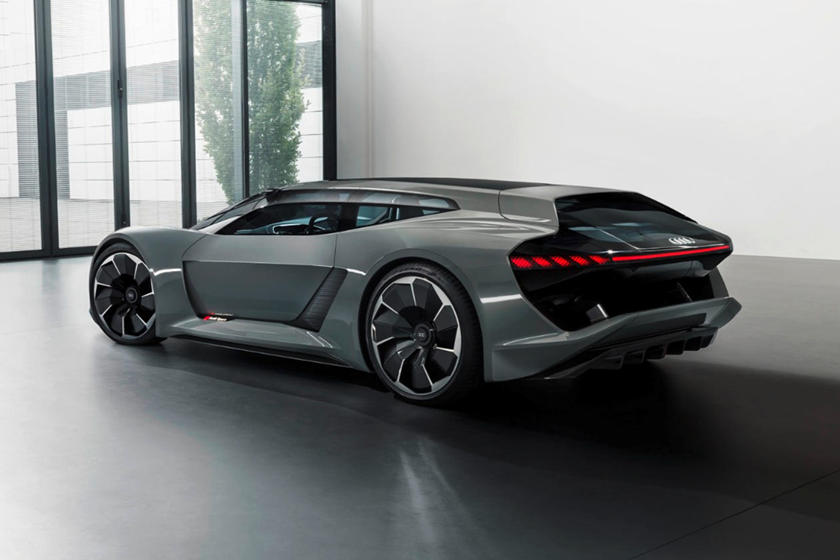
Audi PB18 e-tron Concept

Ok, so we're starting off with a concept car that no one will actually be able to buy, but that doesn't stop us from loving the Audi PB18 e-tron Concept. This all-electric supercar packs three electric motors: a 201 horsepower unit at the front and two other motors at the rear wheels producing 604 hp. Combined output is 671 hp, but 764 hp is available in short bursts. Audi says the car can hit 60 mph in just over 2 seconds and we hope the company finds some way to put it into production.

Infiniti Prototype 10 Concept

Like Audi, Infiniti's big reveal at Pebble beach was a concept car. Unlike the Audi, which may have some chance of eventually reaching production, the Infiniti Prototype 10 is purely a design study. We don't see any universe where Infiniti starts selling an electric one-seater with no roof or windshield, but we like the look of this concept nevertheless.

BMW Z4

At long last, the BMW Z4 has finally returned. The Z4 has been a hot topic for discussion, along with its Toyota Supra twin. Now that it's finally here, we like what we see. The car looks handsome yet aggressive, especially in the M40i trim that BMW showed off at the reveal. We still don't know how much power the car will produce, but rumors estimate between 340 and 380 hp. It is also unknown whether a manual transmission will be offered, so we still have to wait for more details from BMW.

Lamborghini Aventador SVJ

In what was one of the biggest reveals at Pebble Beach, Lamborghini finally pulled the wraps off the Aventador SVJ. We've known that this car has been in development for a while now, and what may be the swan song of the Aventador lineup did not disappoint. The V12 engine now produces 770 hp, and the new ALA aerodynamics system keeps the car planted to the road. All of the power and aerodynamic wizardry culminates in a production car lap record at the Nurburgring of 6:44.97.

SSC Tuatara

What could possibly top a 770 hp Lamborghini reveal? How about a 1,750 hp hypercar from SSC. After much teasing and a long hiatus from building its last hypercar, the Ultimate Aero, SSC returned with the Tuatara. The stats are simply mind-boggling - a twin-turbo 5.9 liter V8 producing 1,350 hp (or 1,750 on E85), a limited production run of 100 units, and the ability "to easily surpass the current [top speed] world record.” Color us impressed.

Ferrari 488 Pista Spider

Lamborghini wasn't the only Italian company to show up with a limited edition supercar. Not to be outdone, Ferarri arrived with the 488 Pista Spider, the drop-top version of its lightweight, special edition 488. Like the coupe, the Pista Spider is powered by a 3.9-liter V8 producing 720 hp and 568 lb-ft of torque. As with the coupe, we are sure that the Spider is already sold out to loyal Ferrari enthusiasts and the price is already on its way up.

Jaguar E-Type Zero

Few cars in history have ever been quite as pretty as the original Jaguar E-Type. Enzo Ferrari once called it the prettiest car in the world. The only trouble with owning one was the constant fear that it would break down before you got where you were going. At this year's Pebble Beach Concours d'Elegance, Jaguar Classic announced that it would put its E-Type Zero concept into production. Now buyers will have the amazing looks of an E-Type with a reliable electric drivetrain - just don't expect it to be cheap.

Porsche 911 Turbo Project Gold

Like Jaguar, Porsche also revealed a special project that takes from the company's history. Porsche Classic, the automaker’s restoration division, has taken an original 993 generation body shell and transformed it into what it calls Project Gold. The car has been thoroughly reworked so that it looks true to the original, while also benefiting from modern enhancements like the Turbo S Exclusive Series paint.

Powering the Project Gold is a brand new 3.6-liter twin-turbo flat-six engine developing 450 hp. The car will be auctioned off next month at RM Sotheby’s Porsche 70th Anniversary Sale in Atlanta, Georgia, where it will likely go for seven figures.

Bugatti Divo

Last, but certainly, not least is the Bugatti Divo. What more can we say about this magnificent creation from Bugatti? Like the Chiron, the Divo is powered by an 8.0-liter W16 engine pumping out 1,479 hp. Whereas the Chiron is focused on achieving the highest top speed, the Divo is built to tackle race tracks with optimized aerodynamics as well as chassis and suspension tuning. As a result of all of the changes, the Divo will "only" hit 236 mph instead of 261 mph, but it will be extremely rare with only 40 units slated for production at $5.8 million a pop.

Friday, 5 April 2019

5 Pairs Of Awesome Cars You Can Buy Instead Of One Tesla Model 3

For the price of a Model 3, you can have an economical daily driver and a fun sports car.

Tesla attracted a lot of attention with the promise of an affordable $35,000 model. Over 500,000 people put down a deposit for a Model 3, but Tesla has yet to deliver on its $35,000 car promise. Many people have pulled their deposits, because the cheapest Model 3 on sale right now costs around $45,000. Instead of waiting for the cheaper Model 3, we suggest buying two cars. For less than $45,000, you can afford an economical daily driver, and a fun sport car for weekends.

BMW i3 & BMW M3

Our first pair of cars comes from BMW, and combine to serve the same job as the Model 3. A new BMW i3 costs about $45,000, which is around the same as the long range Tesla Model 3. Fortunately, used examples can be purchased for as low as around $14,000, leaving around $31,000 for a fun car. Unfortunately, the original i3 only had an electric range of 73 miles, or 150 miles with the gasoline range extender. The i3 will be fine for people with a short commute to work, and you'll be able to take longer journeys in the next BMW on the list.

The Model 3 is already quite expensive with options, but a more powerful M3-rivaling model is on its way. The Tesla will be incredibly quick with a 3.5-second 0-60 mph time, but it will also cost around $65,000. For around $30,000, you can get the previous generation E90 M3. It may not be as fast or as modern as the Tesla, but the M3 will be much more enjoyable to take on a fun roads thanks to its wonderful 414-hp 4.0-liter V8 engine. The gas mileage may be atrocious, but that's why you'll have the i3 to drive around every day.

Mitsubishi i-MiEV & Lancer Evolution

This next pair of cars can actually be purchased for less than the cost of the $35,000 base Model 3. The Mitsubishi i-MiEV was a poor seller in the US, likely due to its odd looks and lackluster 62-mile range. Since EV models become out of date quicker than cell phones, used i-MiEV models are now incredibly cheap, as little as around $5,000. It may be no where near as prestigious as the Tesla, but it does allow for plenty of money to spend on a fun car.

Of course, if you buy an i-MiEV for around $5,000, you'll have plenty of cash to spend on any fun sports car you want for the weekends. For the sake of keeping this list organized by automaker, we've chosen the Mitsubishi Lancer Evolution. $25,000 is plenty to buy the last generation of Mitsubishi's sport sedan, the Evo X. The 10th generation Evo produced 296 hp from a 2.0-liter turbocharged four-cylinder, and provided a legendary driving experience.

Chevrolet Volt & Corvette Z06

The first generation Chevy Volt was a revolution for General Motors. It wasn't a fully electric car, but instead relied on a clever gas-electric combination. The wheels were driven by an electric motor with a 35-mile range, but the gas engine could kick in to charge up the batteries. Together, the gas engine and electric motor combined to achieve 95 MPGe in the city and 93 MPGe on the highway. Used first generation Volt models can now be found starting at less than $10,000.

With the rest of the Tesla's $45,000 budget, you can buy a C6 generation Corvette Z06. The C6 Z06 is powered by a 7.0-liter V8 producing 505 hp. Used examples can be found for under $30,000, and offer incredible performance for the money. The gas mileage won't be great with a 7.0-liter V8, but the Volt will make up for it by barely using any gas.

Toyota Prius & Lotus Evora (Toyota powered)

Although these next two cars do not come from the same manufacturer, they are both powered by Toyota engines. It is not often that we recommend the Toyota Prius, but used models can be found for around $6,000. Unlike the Model 3, the Prius does use gas, but it can achieve over 50 mpg. It may be boring to drive, but our next choice will easily make up for it when the Prius starts to suck the life out of you.

The benefit of owning two cars is that one can be a boring commuter like the Prius, while the other one can be a hardcore sports car. For less than $40,000, you can buy a Lotus Evora, which is powered by a Toyota-sourced V6 producing 276 hp. Unfortunately, the more powerful S model isn't available within the budget. If you want to be a bit more extreme, you can opt for the smaller Elise.

Nissan Leaf & Porsche 911 Carrera S (997 gen)

The Nissan Leaf was one of the first mass-market EV models in the US. The 84-mile range wasn't that impressive back in 2012, and it is extremely outdated now. That is why used Leaf price start as low as around $6,000. Like the other EVs on this list, the Leaf isn't as pretty, fast, luxurious, or useful as the Model 3.But it is much cheaper, allowing plenty in the budget for a second car.

We could have stuck with something from Nissan, but we decided to include something with a bit more pedigree. With the remaining budget, we'd buy a 997 generation Porsche 911 Carrera S. The Carrera S was powered by a 3.8-liter flat-six producing 355 hp. Of course, the whole point of this list was to show just how many options exist for the same price as the Model 3. Some people may not be able to afford paying insurance and maintenance on two cars, but the money could easily be spent on gas for the fun car. You could spend $55,000 on a well-optioned Tesla, or $35,000 on a fun car with $20,000 to spare for gas.